Backward Planning for Assignments: A Precise Framework for Calculating When to Actually Start
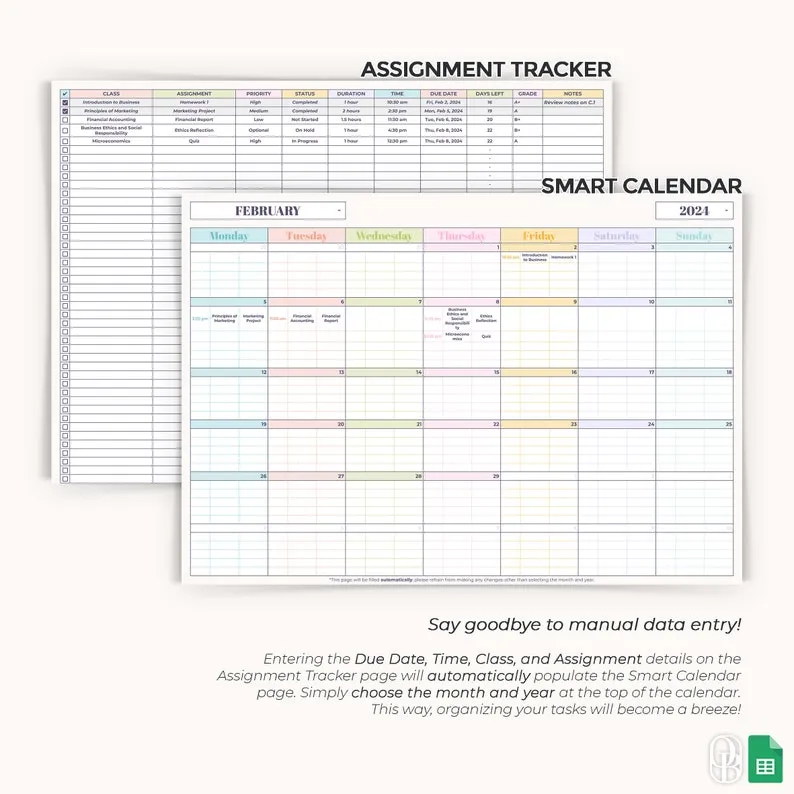
Photo: student planning calendar with assignment deadlines and sticky notes, via i.etsystatic.com
Your Instincts About Timing Are Mathematically Wrong
Here is a finding that will feel familiar to nearly every college student in the United States: you know you should start earlier, you intend to start earlier, and you still do not start earlier. This is not a willpower problem. It is a planning problem — specifically, a problem with the mental models students use to estimate how long academic work actually takes.
Psychologists call this the "planning fallacy": the well-documented human tendency to underestimate the time, costs, and risks of future tasks while simultaneously overestimating the benefits. Students are not uniquely susceptible to this bias, but the academic calendar — with its clustered deadlines, competing priorities, and optimistic early-semester energy — creates conditions that make it especially damaging.
The solution is not motivation. It is arithmetic. Specifically, it is a backward-planning framework that replaces intuition with calculation.
Step 1 — Identify the True Deadline, Not the Submission Deadline
Most students anchor their planning to the submission deadline. This is the first error. The true deadline for any assignment is the point at which the work must be finished — proofread, formatted, cited correctly, and ready for review — not the point at which it gets uploaded to a learning management system.
For most assignments, there is a meaningful gap between those two moments. Build in a minimum buffer of 12 to 24 hours between completion and submission. This window exists to absorb last-minute formatting corrections, citation errors, and the kind of logical gaps that only become visible after a night's sleep.
Write down your true deadline. Everything else is calculated backward from that point.
Step 2 — Classify Your Assignment by Type
Not all assignments consume time at the same rate. Before calculating a start date, classify the work into one of four general categories, each with a different time profile:
Type A — Short Response or Discussion Post (under 500 words) These feel quick, and often are — but they still require reading, drafting, and light revision. Realistic total time: 1 to 2 hours. Start date: 2 days before true deadline.
Type B — Standard Essay or Report (500–1,500 words) This is the most common undergraduate assignment format. It requires source research, outlining, drafting, and at least one revision pass. Realistic total time: 4 to 8 hours across multiple sessions. Start date: 5 to 7 days before true deadline.
Type C — Research Paper or Case Study (1,500–4,000 words) These assignments involve substantial source evaluation, structured argumentation, and multiple revision cycles. Realistic total time: 10 to 20 hours. Start date: 10 to 14 days before true deadline.
Type D — Major Project or Thesis Chapter (4,000+ words or multi-component) These require phased planning, potentially involving primary research, data analysis, or collaborative components. Realistic total time: 20 to 50+ hours. Start date: 3 to 6 weeks before true deadline.
If your assignment does not fit neatly into one category, round up to the more demanding classification. Underestimation is the enemy.
Step 3 — Account for Your Actual Daily Availability
The planning fallacy is compounded by a second error: students plan based on ideal daily availability rather than realistic daily availability. A student might estimate that they can dedicate three hours per day to an assignment, when their actual focused work capacity — accounting for classes, commuting, part-time employment, meals, and genuine cognitive fatigue — is closer to 90 minutes.
To calibrate this honestly, track your actual productive academic work time for three consecutive days before your next major assignment begins. Most students discover their realistic daily capacity is 30 to 50 percent lower than their assumed capacity.
Divide your total estimated hours (from Step 2) by your realistic daily availability. The result is the minimum number of days the assignment requires. Add two to three additional days as a structural buffer. That is your start date.
Example: A Type C research paper estimated at 15 hours, with a realistic daily capacity of 90 minutes (1.5 hours), requires a minimum of 10 working days. Add a 3-day buffer: start 13 days before the true deadline.
Step 4 — Map the Work Phases, Not Just the Hours
Raw hour counts are necessary but insufficient. Effective backward planning also requires mapping the sequential phases of an assignment, because some phases cannot begin until others are complete — and some phases require time away from the work to be done properly.
For a standard research paper, those phases typically look like this:
- Topic clarification and source identification (Days 1–2)
- Source reading and note-taking (Days 3–5)
- Outline construction (Day 6)
- First draft (Days 7–9)
- Rest period — step away from the draft entirely (Day 10)
- Revision and restructuring (Day 11)
- Proofreading and citation check (Day 12)
- Buffer and submission (Days 13–14)
Notice that the rest period is built in as a non-negotiable phase, not an optional luxury. Research in cognitive science consistently demonstrates that returning to written work after a genuine break produces higher-quality revisions than continuous editing sessions. Scheduling that gap deliberately is what separates structured planning from rushed drafting.
Step 5 — Pre-Commit to the Start Date in Writing
Calculating a start date is not the same as honoring it. The final step in this framework is converting the calculated date into a committed calendar event — not a reminder, not a mental note, but a blocked time slot with a specific task attached.
The task for Day 1 should be narrow and achievable: read the assignment prompt carefully, identify any unclear requirements, and locate two to three initial sources. A small, concrete first action lowers the activation energy required to begin and interrupts the delay cycle before it establishes itself.
Students who use services like WeDoAssignmentHelp most effectively are often those who have already engaged with this kind of structured planning — they know what they need, when they need it, and what role professional support plays within a deliberate academic workflow rather than as a last-minute rescue.
Why This Works When Motivation Does Not
The framework above does not ask students to feel more motivated, care more deeply about their coursework, or transform their relationship with procrastination through willpower alone. It asks them to do arithmetic.
Deadlines stop being crises when they are treated as the final point in a planned sequence rather than a fixed wall approaching at unpredictable speed. The students who consistently meet deadlines without panic are not harder workers or more gifted planners by nature — they have simply internalized a calculation process that most students never learn to apply systematically.
Start with your next assignment. Classify it, calculate the hours, map the phases, and commit to a date. The math will tell you what your instincts cannot.